
David Sarnoff©
"He was not an inventor, nor was he a scientist. But he was a man of astounding vision who was able to see with remarkable clarity the possibilities of harnessing the electron."
New York Times obituary of David Sarnoff
December 13, 1971
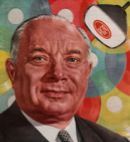
By today's standards, Sarnoff's youth was insufferable. Left by his father, his mother handed him off to a distant relative to teach him Hebrew, Aramaic and the Talmud somewhere in the vast expanses of the Russian Pale. Next, he was relocated to the polyglot, teeming masses of New York's lower East Side, where he had to work to support his family while learning English and attending school. He was not yet ten. Sarnoff simply never had a childhood. Today, such trauma would be unthinkable. Counseling would be called for. But for Sarnoff, it helped spur the kind of dogged determination he demonstrated throughout his career as the leader behind two of the twentieth century's most influential mediums, radio and television.
Born February 27, 1891, in Uzlian, a Russian Shtetl near Minsk, David Sarnoff was five when his father, Abraham, left to pursue opportunities in America. That same year, his mother, Leah, parceled him out to a granduncle to study the Talmud in hopes he would become a rabbi. Four years later, with his mother and younger brothers, he immigrated to America in the cheapest steerage available. It took them through Latvia, England, and Canada en route to New York where months later, they would rejoin their ailing father.
Abraham's worsening tuberculosis would kill him ten years later, but in 1900, it meant David had to go to work immediately to help the family survive. Nine years old, he began selling Yiddish newspapers before and after school (and choir practice). He attended both day and night school and grabbed discarded English language newspapers to teach himself English. Ever the go getter, by 1904, Sarnoff had saved $200, bought his own newspaper stand, and put his siblings to work with him.
His formal education ended in 1906 when his father's deteriorating health meant he had to work full time. He wanted a job at a newspaper, but went through the wrong door and ended up as a messenger for an undersea cable company. Three months later, refused time off to sing in his choir for Rosh Hashanah and Yom Kippur, he either quit or was fired (sources vary). But by then he knew something about telegraphy. The possibility of becoming a telegraph operator drew him to American Marconi Wireless Company where he started as an office boy.
Only eleven years earlier, wireless communication had been invented by the non-Jew Guglielmo Marconi. Within four years, the British had formed the European parent, Marconi Company, and its American subsidiary, which Sarnoff joined in 1906. At inception, wireless was only seen as a technology for instant ship-to-shore, and overland Morse code telegraphy. Seven years passed before Lee De Forest, an American Gentile, came up with a way to use wireless to transmit voice as well as Morse code. With that new wrinkle, the potential for wireless exploded, but like many new technologies, it took time for that potential to be understood.
In today's terms, it would be akin to a teenage immigrant starting in a promising Silicon Valley start up just as the personal computer, Internet, cell phone and high speed "broadband" communications arrived on the scene. The visionary Sarnoff recognized the opportunities.
As an office boy, Sarnoff was Marconi's personal assistant whenever the founder was in New York. Sarnoff ingratiated himself to Marconi, studied the technology, took night school and correspondence courses, and within a year was a "junior telegraph operator." The next year he was promoted to "full operator" and by 1910, the nineteen year old Sarnoff was the Company's youngest station manager.
On April 12, 1912, working as a remote telegraph operator atop New York's John Wannamaker Department store, he was one of the few who heard and responded to the faint wireless signals coming from the sinking Titanic. Over the next 72 hours he received, and passed along to the anxious crowds outside, information learned from the ships trying to save passengers. His superiors were impressed.
He was made an equipment inspector and instructor and by 1913, he was American Marconi's chief inspector and its assistant chief engineer. At age twenty-two, he was traveling to ships and trains to see wireless equipment in action, visiting all of Marconi's U.S. facilities, those of inventors, such as Lee De Forest, and those of Marconi's competitors.
His perceptiveness and vision are laid out in a 1916 memo to his boss, Marconi Vice President and non-Jew, Edward J. Nally. Sarnoff proposed that the Company develop and market a "radio music box."
"I have in mind a plan of development which would make radio a 'household utility' in the same way as a piano or phonograph. The idea is to bring music into the house by wireless. . . (it) need not be limited to music (but could also be) a wireless classroom. . . Events of national importance can be simultaneously announced and received. Baseball scores transmitted. . . Farmers and others living at a distance could be greatly benefited. . . they could enjoy concerts lectures, recitals, etc."
Sarnoff was not the first to conceive of radio. Since 1906, pioneers had been experimenting with De Forest's technology, but no one saw its potential as clearly as Sarnoff did, and no one was as committed to creating radio broadcasting as a commercial endeavor.
Nally did not pick up on Sarnoff's proposal. The Company was satisfied selling wireless equipment for naval communications and equipment used to transmit signals from one person to another. "Broadcasting" signals to a large audience, as Sarnoff was suggesting, would be a diversion. But Nally was impressed. By 1917, twenty-six year old Sarnoff was supervising 725 employees in 582 Marconi installations. His task was so important he was denied a U.S. Navy commission to fight in World War I. They needed him where he was.
At War's end, the U.S. Government decided wireless technology was too vital for American security to be dependent on foreign ownership of American Marconi. Instead, General Electric (GE), United Fruit Company, Westinghouse, and later American Telephone and Telegraph, were encouraged to form a 1919 consortium to buy out the British interests, pool their patents and know-how and create what they renamed, Radio Corporation of America (RCA). A GE Vice President served as RCA's first Chairman and Nally, by now also working at GE, became its part time President. As Nally's right hand man, twenty-eight year old Sarnoff was effectively RCA's Chief Operating Officer.
A lengthy 1920 Sarnoff memo laid out his proposal for radio once more, and this time in greater detail. A copy went to GE, where money was set aside to build a prototype. Cross licenses were created between RCA, GE, AT&T (for Lee De Forest's inventions), and the inventor of a simple radio tuner. Around the same time, hobbyists began using crystal sets and Westinghouse began broadcasting in Pittsburgh. In early 1921, thirty year old Sarnoff was formally named RCA's general manager and the next year, its Vice President.
In 1921, Sarnoff showed his promotional flair with a live July 21st broadcast of the Jack Dempsey, Georges Carpentier heavyweight championship fight. An estimated 300,000 people tuned in. His vision was proven as radio came on the scene. It was an immense success. Twenty-eight radio stations in 1921 became 576 stations the next year. Industry sales (GE, Westinghouse, RCA and others) went from $60 million in 1922 to $358 million by 1924. RCA's $11 million of 1922 radio revenues climbed to $50 million by 1924 (all in 1922-24 dollars.) Soon, the pursuit of radio profits by the individual companies around RCA (GE, Westinghouse and AT&T) found them competing with one another. Finally, in 1926, AT&T chose to sell its broadcasting network to RCA. Sarnoff combined it with RCA's, in the process creating the National Broadcasting Company (NBC), with two networks (NBC Red and NBC Blue), as a wholly owned subsidiary of RCA. Because of subsequent FCC anti-trust concerns, NBC had to sell NBC Blue and today it is known as the American Broadcasting Company (ABC).
Meanwhile, in the 1910s, Sarnoff had seen the potential for television. By 1923, he was promoting it just as he earlier promoted radio. By 1928, he had an experimental NBC television station up and operating. In one memo, he referred to television as "the technical name for seeing instead of hearing by radio." He anticipated viewers seeing events around the globe as they occurred, and he saw a linkage with movies. He said:
"transmission and reception of motion pictures by radio . . . would result in current events or interesting dramatic presentations being literally broadcast . . . and, therefore, received in individual homes or auditoriums . . . on a screen with much the appearance of present day motion pictures."
His clairvoyance drove Sarnoff to pursue a broad pallet of opportunities. In the 1920s and '30s, as RCA was producing and selling radio equipment, licensing its technology, and creating and broadcasting programs. He also:
- Created the national system of affiliated radio stations we now think of as a "network," first within RCA and later as part of NBC.
- developed television.
- acquired The Victor Talking Machine Company, (a leading phonograph company),
- formed a union with Joseph Kennedy to create Radio-Keith-Orpheum (RKO) to produce movies and operate movie theaters,
- acquired two large music publishers, and
- started a talent agency.
Sarnoff created a 1920's vision of today's entertainment conglomerate. He saw the "synergies" and turned them into reality. Today's Viacom, Time Warner, and Disney have nothing on 1920's RCA under David Sarnoff. Later, in the '60s he was to add publishing to the mix with the acquisition of Random House and he foresaw the development of videotape and the VCR.
The interconnections between RCA, GE, Westinghouse and AT&T were not only troublesome at a competitive level, they also led to governmental anti-trust intervention based on the exclusive patent sharing relationships between the companies. The new Federal Communications Commission was beginning to investigate as well. It all worked to Sarnoff's benefit. AT&T stepped away when RCA acquired its broadcasting operation. Since that time, Sarnoff had first been named acting-President in 1928, and President in 1930, when he was thirty nine. Two years later, GE and Westinghouse divested their RCA interests leaving Sarnoff on his own and in complete charge.
Though the Depression slowed down RCA, radio continued to grow as Sarnoff began aggressively pursuing television. He had already set up the experimental NBC studio and in 1929, he underwrote the efforts of Vladimir Zworykin, the immigrant Russian inventor of the first TV camera. RCA also began to license or acquire patents from other inventors and by 1939, Sarnoff was able to demonstrate RCA's first television at the New York World's Fair. At that event, Sarnoff said, "Now we add sight to sound. . . It is . . . the birth in this country of a new art, so important in its implications that it is bound to affect all society." By 1941, NBC launched commercial broadcasting from its station, WNBT in New York.
World War II intervened and RCA focused on the war effort. It devoted the bulk of its resources to the Allies' needs for radio, sonar and other communications gear. Meanwhile, Sarnoff was recruited as a communications consultant to General Dwight Eisenhower. By war's end, he was a brigadier general, a title he coveted for the rest of his life.
The war over, Sarnoff was back developing commercial television. In 1946, RCA manufactured 10,000 television sets. By 1954, it had grown to a million a year. Along the way, Sarnoff fought and won a tragic victory over an old friend who had created FM radio. FM offered better quality reception than AM and non-Jew, Edwin Armstrong, was its inventor. Unfortunately, Sarnoff and RCA saw Armstrong's FM as a competitor both for its own AM and for the new FM technology RCA had developed to compete. Sarnoff succeeded in getting the FCC to change the licensable FM frequencies, in the process making Armstrong's equipment obsolete. In addition Sarnoff and RCA tied up Armstrong's commercial offerings in the courts until his patents had nearly run out. In the end Armstrong conceded by licensing his patents for little gain but he later committed suicide. This time, Sarnoff's determination had tragic consequences.
He waged a similar war with non-Jew Philo Farnsworth, a major figure in the development of television. Farnsworth felt RCA and Zworykin had taken advantage of him. He won in the courts, but lost in the market. When he finally licensed his patents, they had nearly run out and he never earned the millions he thought he deserved. When Sarnoff was called "ruthless" for his aggressive style, he responded, "Competition brings out the best in products and the worst in men."
Sarnoff's next challenge was color. CBS was developing a unique technology for color television. By contrast RCA's was based on existing technology. Both companies needed FCC approval for their standards but CBS got theirs' first. Despite FCC delays in approving RCA's standards, Sarnoff had an advantage. His color sets and broadcasting technology were compatible with existing black and white sets. Fortune intervened in the form of the Korean War which slowed the development and marketing of CBS' color equipment and televisions. Meanwhile, the numbers of less expensive black and white televisions grew as more and more Americans bought sets. By 1953, the presence of 20 million black and white televisions in consumer homes around the Country led the FCC to conclude it could not afford to obsolete them. It approved RCA's standards and with that, Sarnoff had won. While CBS could also sell its color televisions, RCA had an unbeatable advantage and within a year, CBS withdrew from the market.
Before he died, on December 12, 1971, Sarnoff was able to view digital photographs taken by RCA satellites, downloaded electronically to ground stations where they were reproduced and distributed.
A great visionary of immense personal drive, Sarnoff was the single most important figure behind the creation and development of radio and television. This was true in every aspect of both industries. In broadcasting equipment, broadcast networks, radio and television programming, and in-home consumer radio and television sets Sarnoff set the path and the pace. No one since has replaced his force in shaping telecommunications. Twice on the cover of Time Magazine, they also recognized him as one of the "100 Most Important People of the Twentieth Century."
