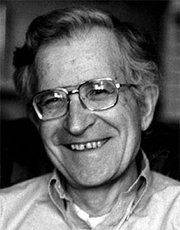
Noam Chomsky©

"Language is a process of free creation; its laws and principles are fixed, but the manner in which the principles of generation are used is free and infinitely varied. Even the interpretation and use of words involves a process of free creation."

Noam Chomsky

"If the Nuremberg laws were applied, then every post-war American president would have been hanged."

Noam Chomsky

"Propaganda is to democracy what the bludgeon is to a totalitarian state."

Noam Chomsky
William (Zev) Chomsky fled Russia in 1913 to avoid being drafted. Elsie Simonofsky emigrated as well, though in her case from Lithuania. William began in the sweatshops of Baltimore, but self educated in Russia, he soon gravitated to teaching at Baltimore's Hebrew elementary schools while working his way through Johns Hopkins. He graduated with a PhD, specializing in the Hebrew language, about which he wrote and taught for most of his life.

He met and married Elsie, who also taught Hebrew, and after his graduation they moved to Philadelphia where they taught at the Mikveh Israel congregation religious school. On December 7, 1928, Elsie gave birth to the first of their two sons, Avram Noam Chomsky.

In the words of his New York Times obituary, "William became one of the world's foremost Hebrew grammarians." His was a warm and outgoing personality, influential in his field of expertise, and he drew Noam into his love of intellectual matters, academia and language. When he was only 12, Noam was already reviewing one of his father's five books. Late in life, William said his life's major objective had been "the education of individuals who are well integrated, free and independent in their thinking, concerned about improving and enhancing the world, and eager to participate in making life more meaningful and worthwhile for all." It is a telling description of both his aspirations and his effect upon Noam.

Chomsky's mother matched William as an intellectual and teacher. More austere, she was also more outwardly political and leftist in her thinking. Noam was shaped by a family life centered on active involvement in Jewish issues, including the revival of Hebrew, Zionism and Jewish cultural activities. In the end, Chomsky was a product of both parents. His interest in language, and his warmth and humor came from his father. His lifelong left wing anarchist/libertarian and socialist political orientation came from his mother, and both parents contributed to his intellectual talent and willingness to speak out openly and vigorously in support of his academic and political views

At school Noam often the led class discussions and it was there, when he was only five, that he met three year old Carol Doris Schatz. In 1949 she became his lifelong wife, partner and later, the mother of their three children.

Bright and competitive, a family friend sought to make conversation with young Noam, asking if he had looked through any of the volumes of Compton encyclopedias in the Chomsky home. Seven year old Noam replied he had only read half of them. By the time he was 10, he was writing editorials on the Spanish Civil War for the school newspaper, and by 12, he became an avowed anarchist who had rejected Marxism.

Chomsky entered the University of Pennsylvania in 1940 to study linguistics under Zellig S. Harris, a charismatic leftist liberal who's political views attracted the sixteen year old as much as his reputation in linguistics. Noam had, of course, the benefit of a family background which already gave him a solid grounding in linguistics. Harris had a substantial influence on his protege, but the student's linguistic insights ultimately went far beyond those of his mentor. After earning his PhD in 1955, Chomsky started teaching modern languages and linguistics at Massachusetts Institute of Technology, where he became a full professor in 1961, and where remains to this day, having served in various visiting professorships on other campuses over the years.

Chomsky's 1955 doctoral dissertation and lecture outline served as the basis for his 1957 book, Syntactic Structures. In the words of Encyclopedia Britannica, that book "revolutionized the development of theoretical linguistics." Not bad for a newly minted PhD.

Before Chomsky, linguistics was something of a dry, esoteric field within academia. It taught that language was essentially a system of phonetic, grammatical and syntax habits learned through training and experience. Linguistics in that context, was a discipline devoted to naming and describing the parts and features of different languages, without regard to the meaning (or semantics) of the utterances. Further, at the time, most academics believed language was learned through behavioral conditioning, the Pavlovian stimulus/response notion in which subjects were "trained" by rewarding good, and penalizing bad behavior. Behavioral conditioning was championed by Harvard's psychology professor B.F. Skinner, who, among other proofs, had used his technique to teach pigeons to play ping pong. He believed so completely in his own theories that his daughter, Deborah, slept in his invention of a climate controlled crib/playpen (some called it "a baby in a box)," for her first two and a half years. In 1959, Skinner wrote Verbal Behavior positing that language was simply learned by conditioning. That same year, Chomsky wrote his critique of Skinner's book

Chomsky's insight was derived partly from his study of the ways mathematicians derive an infinite number of proofs from a limited number of postulates, principles and inferences. He thought perhaps something analogous occurred in language with its limitless ways of expressing a single idea. Chomsky posed a simple hypothetical question to challenge the behaviorists and support his own views. Namely, if language is learned from conditioning, how is it that a child who has just begun speaking can devise an astonishing variety of utterances? Chomsky posited that the human capability for language is innate. He explained that a young child could not possibly have been exposed to all the combinations of words it so easily demonstrates in every day speech.

Chomsky was also supported by the facility of young children, particularly between the ages of three and ten, to quickly learn language (even multiple languages) in ways adults cannot. Moreover, research has shown children learn almost unaided, or if aided, derive little incremental benefit from the training. Moreover, an adult's attempts to correct a child's grammatical mistakes generally have little effect until the child naturally gravitates, over time, to the correct grammatical form.

Said differently, if behaviorists conceived of the mind and its language skills as something of a "blank slate", (or a software program with but few initial instructions), Chomsky's formulation implied humans are born with an innate language capability – software resident in the brain, as it were - which already includes many of the instructions to be fired up for use at the appropriate point in maturation.

Chomsky's points convinced many that his explanations were more viable than simple conditioning. In the process he changed both linguistics and behavioral psychology. It was perhaps no coincidence that early work in socio-biology was arriving on the Harvard scene at about the same time Chomsky was developing and describing his theories. Socio-biology was also skeptical of conditioning (and "nurture") as the dominant explanation for behavior. Like Chomsky's linguistics, socio-biology explored the effect of genes (or nature) on behavior, personality and orientation. Both approaches convincingly challenged the proposition that humans are simply "blank slates" which can be programmed to think, believe and, act in particular ways.

Chomsky believed we all share an innate sense of the simple rules, or basic structural ways of thinking, and expressing. He theorized that these rules are common to various languages, and that once we know the words and grammatical rules employed by a specific language, we can quickly begin applying the innate rules to frame thoughts and utterances (words, phrases and sentences) in almost infinite numbers of combinations as we express ourselves. Beyond that, Chomsky said "utterances" involve two levels. At the first, or surface, level, are the actual words and sounds we use and hear. At a deeper level, is the meaning of an utterance. We construct the surface level utterances using rules from the "deeper level," selecting the specific words we have learned and placing them in the allowed sequences to create and transmit meaning. Conversely, the same rules are used to hear and understand the utterances of others.

As Encyclopedia Britannica notes, "Chomsky's work virtually defined the methods of linguistic analysis used in the second half of the twentieth century." His approach revolutionized the somewhat stale discipline of linguistics, extended its scope to encompass the underlying thought and meaning of utterances. In the process he expanded linguistics to both draw upon and influence: biology, psychology, philosophy, computer programming, and other fields. The 1984 Nobel Prize for Medicine and Physiology went to Niels K. Jeme who used Chomsky's "Generative model" to help explain the human immune system.

While many of Chomsky's theories have been challenged by his peers over the years, some of his seminal insights remain widely accepted. And nearly everyone agrees it was Chomsky who revolutionized linguistics.

A few years after receiving tenure in 1961, Chomsky's outspoken views on politics and economics began to emerge. Perhaps the impetus for the popular 1960's bumper sticker, "Challenge Authority," from 1964 on Chomsky criticized U.S. involvement in Viet Nam, culminating in his 1969 publication of American Power and the New Mandarins. With the book and his public pronouncements and articles, Chomsky became a cult figure of the American, and later the European left. He began to publicly espouse the anarchist and socialist views developed in early childhood and they become an ever greater part of his work and public commentary. It was as though Chomsky had created a second endowed chair for himself. He made himself into a full professor of anarchist/libertarian socialism.

In Chomsky's paradigm, anarchy did not encompass violent acts to destroy all government so much as a view that all government, corporate, and other forms of power and authority are suspect; only those essential should be accepted. As the world's most powerful government, the United States became his principal perpetrator of evil and whipping boy.

A second element of his world view was his belief in socialism and his rejection of capitalism, which he saw as authoritarian and repressive of individual freedoms. In the same sense, he reiterated his rejection of Marxism and Leninism. This led him to criticize the Soviet Union, albeit with much less vehemence than the United States. Democratic capitalism came in for particular contempt. In interviews, Chomsky was quoted saying "American democracy was founded on the principle. . . that the primary function of government is to protect the minority of the opulent from the majority."

Chomsky's world view seems to envision humans as naturally cooperative and sharing. Power inhibits the pure libertarian socialistic impulse. Humans could enjoy their deserved political and economic world if only nefarious groups and individuals who control power were eliminated. Absent the coercion, human beings would naturally work together and cooperate in a socialistic economy for the benefit of all.

While Chomsky has said he does not wish to create the impression he completely understands human nature, his political/economic paradigm involves a Rousseau like belief in something akin to "the noble savage," also popularized by Franz Boas and Margaret Mead. In that view, the noble savage, left untouched by a corrupting civilization, is pure, innocent, and happy. Chomsky has said the purest model for the kind of political and economic culture he envisions was 1930s Spain when the Republicans took power. His description also harkens back to Tito's Yugoslavia where each factory was to be democratically run by its workers. It is also reminiscent of the kind of 1940s/50s Israeli kibbutz which Chomsky contemplated joining in his teens.

For Chomsky, third world citizens are the purest remaining representation of innocents who continue being devastated by evil U.S. and its capitalist power (with historical Western Europe occasionally thrown in for good measure.) When challenged by those who say he has been unwilling to equally criticize other countries, institutions and individuals whose behavior is as bad or worse, Chomsky's consistent defense is that his duty is to focus on the country he is most capable of influencing. Presumably he would have limited impact on the others and must focus his energies on the country of which he is a citizen.

The chronicle of Chomsky's campaigns and criticisms include:

Chomsky and colleague, Edward Herman also developed their theories of propaganda, which they see as a tool used by those in power to control public thinking in supposed democracies. Not necessarily an outright conspiracy directed by individuals, instead they theorize an institutionalized system of filters involving: 1) concentrated media ownership; 2) the effect of advertising as the principal source of income; 3) media reliance on business, government and experts to provide information; 4) the use of "flak" to discipline recalcitrant media; and 5) use of anti-communism, in the 1970s and 1980s, as a constant theme. Together the five filters control the media limiting the content and spin of programming. They inhibit the free expression of facts and truth. Instead, they condition the populace to the views of a powerful elite, since that is all the filters allow through. Thus, despite thinking of ourselves as a democracy, in fact, powerful corporate and government interests control our thinking and attitudes and thereby keep themselves in power, by merely entertaining and manipulating citizens, in a manner akin to what the Romans allegedly did with their circuses and other forms of public entertainment.

Astonishingly outspoken and acerbic, even acid in his comments, Chomsky has invited a hail of critics who respond to the controversial nature of his views with matching vitriol. Among them is Arthur Schlessinger, who said, "One can only conclude that Chomsky's idea of the responsibility of an intellectual is to forswear reasoned analysis, indulge in moralistic declamation, fabricate evidence when necessary and shout, always at the top of one's voice." Anthony Lewis criticized Chomsky for his defense of Pol Pot, and former supporter, Christopher Hitchens, finally broke with Chomsky after Chomsky likened 9/11 to the missile strike on the Sudan chemical/pharmaceutical factory. Chomsky has elicited particularly harsh criticism from fellow Jews, some of which now see him as a "self-hating Jew" or "no longer Jewish." Among the prominent Jewish critics are Alan Dershowitz and David Horowitz, both of whom challenge Chomsky on wide ranging of fronts.

Interestingly, Chomsky has recently been among those criticizing deconstructionist and postmodern dogma. He has called much of deconstruction: "truism, error or gibberish" and has said he finds deconstructionist criticism of "white male science," akin to pre World War II German criticism of "Jewish physics." For Chomsky, the science is valid or wrong, but its origin is only incidental to that truth. And further, he supports the notion that there is such a thing as scientific fact, independent of the person who discovers or proves it.

Despite the controversies, Chomsky has earned more than 20 honorary degrees from the likes of Cambridge University, Harvard, Swarthmore, Delhi University, Amherst, the University of London Georgetown, and others. He has written more than 70 books and a thousand articles. The measure of his influence is characterized in the comments of Paul Robinson in a New York Times Book Review saying, "Judged in terms of the power, range, novelty and influence of his thought, Noam Chomsky is arguably the most important intellectual alive today." London Times named Chomsky "one of the thousand makers of the twentieth century," and Christopher Lehmann-Haupt in the New York Times has called him "the foremost gadfly of our national conscience."