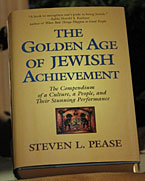
Introduction©

Asked why he, a Gentile, was donating $1 million to the Aish Ha Torah's World Outreach Center in Jerusalem, the successful American entrepreneur, John Kluge, responded:

'Last year I turned 80 years old. At my birthday party, I realized 85 percent of my friends are Jews. I have always admired the Jewish people and their contributions to humanity, to civilizing the World. What Aish Ha Torah is doing to reconnect Jews with their heritage, to strengthen their roots, to educate them of their values, is enabling the Jewish people to continue to be able to play their incredibly valuable role in history.'

What follows can hardly compare with Kluge's generosity, but it arises from a similar impulse: recognition of many rich and rewarding friendships, appreciation for the immensely valuable role Jews have played over their 4,000 year history, and an effort to explore their achievements and the culture that brought them about.

A Presbyterian by upbringing, of Scots Irish, English and German heritage, I cannot claim any Jewish genes. Instead, from my kindergarten playmate, to the boss who gave me my first shot at line management, countless associates, Board members to whom I reported, employees who reported to me, and numerous competitors, associates, fellow board members and friends, Jews have played a long and important role in my life. Without demeaning non-Jews, the vitality and determination of Jews has been as delightful as the warmth of their friendship and pleasure of their humor. In the later Chapter on Education, Gordon Gee, President of Vanderbilt is quoted as saying, Jews 'by culture and by ability and by the very nature of their liveliness, make a university a much more habitable place in terms of intellectual life.' That has been my experience and it contributed to the motivation for this book.

The primary audience for this book is non-Jews, but the ironic likelihood is that it will be read mostly by Jews. They, of course, have interest in their most accomplished people, and in the commentary about their culture of achievement. Jews also tend to be substantially more well read and more likely to read, study, and debate such issues than their non-Jewish contemporaries. That observation is sustained by much of what follows in this book.

My message is directed at recognizing just how important their performance has been, and at the critical role their culture, which arose first from their religion, but evolved continuously over time, has played in creating an ethos wherein high achievement is treasured. Stated simply, culture matters. Exploring and understanding its role can be useful in helping us think about where we place our own values, what we treasure, and the critical inspiration culture provides in shaping us and our succeeding generations.

With that said, I do not presume all of my ideas and theories are correct. Instead, I hope to provoke discussion and debate. I believe this book, and the facts it reports, clearly prove the disproportionate performance of Jews in this, their Golden Age. But as to the transferable lessons to be learned, hopefully those will arise from the ensuing discussion and be sharpened by it.

One of the more interesting aspects of writing this book was the remarkable ambivalence of so many Jews about the very notion of discussing their disproportionate performance. Almost the first time I raised the subject with Charles, a longtime friend, he was complimented by my interest, but skeptical about my pursuit of the topic. In an early brief presentation of the book's premise to a small mixed audience, one Jewish attendee was impressed and grateful for my interest. Another accused me of anti-Semitism.

The author of an excellent book on a related topic told me of the difficulties on his book tour when, at the last minute, he was cancelled from an interview on National Public Radio (NPR). Reportedly, the cancellation arose from fears NPR would lose the sponsorship of some prominent Jews. The same author told me of his conversation with one very wealthy and prominent Jew who said he would do anything he could to squelch the book's publicity and success. Certainly, my long suffering literary agent saw the same phenomenon firsthand as publishing houses expressed reluctance, not just about the work of an unpublished author, but also the book's chosen topic

There is justification for such concern. If there has been one powerful lesson for Jews over the last two thousand years, it is to keep your head down. In so many civilizations, when times were good, the small Jewish minority was well respected and they prospered from contributions to their country of residence. But when things began to go badly in war, the economy, or some other maelstrom, Jews were typically the first scapegoat. Germany was the most enlightened home for Jews in the late nineteenth-century. In less than twenty years, following Germany's loss in World War I and the later economic melt down, it became history's most horrible embodiment of Jewish hatred. 'Be cautious,' is a message Jews have learned very well. Even when things are going well, circumstances can quickly turn dangerous. Envy of your success can become a powerful driver of your undoing.

There is an intellectually interesting second aspect to this conundrum. That is, singling out one culture for such recognition not only flies in the face of today's politically correct notion that 'all cultures are equal,' it also stimulates concern that it may demonstrate a 'racist' perspective akin to the Aryan superiority gospel of the Nazis, with all the subsequent tragedy that racial theory inspired.

Third, there is the understandable, if occasional, reaction of, 'Who is this non-Jew to think he understands us and is competent to write about us. He is neither a published author, nor a scholar of Judaism or Jewish history.'

In the end, I acknowledge all three points. There is risk such public recognition of their achievements can backfire. And yes, I do dispute the politically correct notion that all cultures are equal, but my views are simply not racist. They are precisely the opposite. They represent an optimistic message. Unlike the determinism of genetics, culture, which is malleable and open to conscious shaping, is seen as a driving force behind the remarkable Jewish performance. It should be similarly possible for other groups to become overachievers as well.

As to chutzpah, I confess. After all, though I hardly compare, it was Daniel Boorstin, the Jewish Pulitzer Prize winning historian and former head of the Library of Congress, who acknowledged historian's debt to amateur historians such as Edward Gibbon, Winston Churchill and Henry Adams.

In an era where anti-Semitism is on the rise in Europe and at the United Nations, when a world of six billion people seems to increasingly vilify Jews, perhaps it can be helpful to lay some irrefutable facts on the table to help non-Jews understand what Jews have contributed. In the process, hopefully some anti-Semitic myths about their historic role and values can be proven wrong. This book raises the notion that Jewish culture provides some lessons from which others can learn.

One late evening conversation with a mildly anti-Semitic Ukrainian friend was instructive. After the discussion and his review of a prospective magazine article on the topic, he became interested in exploring publication of the article in Russia. I took this as positive evidence that while extremists are unreachable, facts, presented in the right way, can influence the attitudes of the open minded. Hopefully, this effort can make that kind of contribution.

A logical question arises from this introduction and the chapters which follow. Am I saying Jews are superior? The answer is no, I am not. There is much to be learned from Jewish history and culture, but this book does not propose Jews are superior. Yes, they are disproportionately accomplished. The book clearly makes that case. And it goes further, suggesting why that may have happened. But it never says, nor does it intend to suggest, that Jews are genetically or in any other way superior to the rest of us.

If it was possible to array all Jews statistically in terms of their achievements and contributions, that distribution would be shaped like a bell (normal) curve. There would be many Jews in the middle and at the bottom of the curve and their combined achievements and contributions would be modest. Compared with other groups, similarly arrayed, two things would be clear. First, the total number of Jews depicted in their bell curve would be small, almost trivial compared to the other groups. Most of the other bell curves would be much larger, representing many more people. (Realize that in a sample of 1,000 of the world's people, only two would be Jews.) Second, most other groups would have members whose achievements and contributions are as important as the most accomplished Jews.

By the standards of 'greatness' in Michael Hart's The 100: A Ranking of the Most Influential Persons in History, ninety-two of history's one hundred most influential people were not Jews and Muhammad and Isaac Newton were ranked one and two respectively. While Jews have done phenomenally well in winning Nobel prizes, 78 percent of the Nobels have gone to non-Jews. And, as is discussed later in the book, Jews have their share of villains, some of them very nasty (Meyer Lansky and Dutch Schultz), others criminally insane (David Berkowitz) and some unethical (Ivan Boesky). Jews have had their share of con men, idiots and embarrassments. The normal curve applies. They are not racially superior. But, their achievements and contributions are disproportionate to their numbers and, in the popular expression of a few years ago, as a group they are 'over achievers'.

Creating a book replete with the lists and statistics required to lay out the disproportionate achievements of Jews risks boring readers to death. As one reader of an early manuscript said, 'Steve, there is no personality here.' Others suggested I reverse the sequence and put the conclusions and observations about culture first and the data after that since they found the conclusions and observations more interesting. In an effort to respond, and hopefully enhance the material, biographical material and anecdotes have been provided to illustrate notions central to some of the book's key points. They break up the lists and numbers, and if they do their job properly, perhaps they entertain while occasionally illuminating.

Without the interest of many supportive friends, this book would never have happened. Danny, Barbara and Linda Kaplan took an early interest, read drafts, made suggestions and introductions. They were often as surprised as I was by the reticence of some Jews. Ed and Carolyn Stolman were similarly helpful in commenting on the book and introducing my work to Rabbi Harold Kushner. Rabbi Kushner was kind enough to talk with his agent and publisher about my efforts and he was helpful in other ways as well. Charles Kremer, Ted Kozloff, Michael Sonnenfeldt, Jeffrey Hirschberg, Fred Perry, John and Libby Brady, Robert Nicholas, Elsa and Gary Nelson, Alycia and Elvin Case, Barbara Thomas and Roger Wright, Toby and Steve Rosenblatt, David Auerbach, Kevin Calhoun, and Andy Weinberger all read the first draft and made many helpful comments. Stan Cohn convened a small group, Peggy Lipson, Sy Lenz and Henry Lasky, for me in Sonoma, and for the price of lunch, they provided helpful insights and suggestions. Kathleen Gurney provided encouragement and suggestions about 'getting published' as did April Eberhardt. Steven Dobbs became interested, introduced me to colleagues and suggested ways to get the material in front of key people and publications. Charles Murray was willing to share his data and review a chapter which discusses his book Human Accomplishment. Thomas Sowell responded warmly to my inquiry and provided inspiration on many key points.

In the end, four others deserve great thanks. Alex Carlin helped me develop the book's Web site. Janet Volkman spent countless hours reading and editing the material. Literary agent, Michael Larsen, spent even more hours seeking out a publisher and counseling me on ways to best develop the manuscript and market it. But it was my long suffering wife, Joyce, who had to read and re-read the material, put up with my writing at all hours and through it all she provided continuing love and support for a project that became much more consuming than either she or I ever envisioned when it began.