Milton Friedman©

"There's no such thing as a free lunch."

Milton Friedman

"The Great Depression, like most other periods of severe unemployment, was produced by government mismanagement rather than by any inherent instability of the private economy."

Milton Friedman
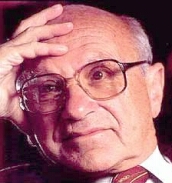
In the 1890s, teenagers Jeno Saul Friedman and Sarah Ethel Landau left Berehovo in the Ukraine to emigrate to the United States. Jeno opened and ran a series of small businesses as a garment maker, dry goods retailer, owner of an ice cream parlor and later, a jobber and petty trader.

Sarah worked as a seamstress and, after they were married and had children, she ran a dry goods store. Given the uncertainty of Jeno's income, they both worked to support themselves and their four children. Despite the economic insecurity, it was a warm and close family.

Milton, born July 31, 1912, was the youngest of the four and the only boy. As a youngster, he was a devout Orthodox Jew. He attended Hebrew School and followed every Orthodox practice until shortly before his Bar Mitzvah, when he became an outspoken Agnostic. Nonetheless, he went through with the Bar Mitzvah for his parents' sake.

An excellent, he started college at 15. Rutgers gave him a partial scholarship, and he worked as a part-time clerk, waiter, and entrepreneur competing with the Rutgers' bookstore at buying and reselling used textbooks to earn the rest of his expenses.

In summer, he sold Fourth of July fireworks and set up a school teaching failing high school students for fifty cents an hour. Perhaps it was his time as a waiter that led to his statement about no free lunches. But his entrepreneurial efforts to pay for college gave him first- hand experience with free enterprise.

He planned to become an actuary until he discovered economics, and took classes with Arthur Burns and Homer Jones who became well-known economists. They mentored and inspired Friedman, encouraged him to pursue postgraduate study at the University of Chicago, and helped him get a scholarship.

From those first days at the University of Chicago in 1932, Friedman was exposed to not only some of the great economics teachers of the era, but also to brilliant fellow students in free and open debates about economics. There, he also met Rose Director, his future wife and partner.

After getting his Master's Degree from Chicago, he took a year at Columbia University to supplement what he had learned about economic theory with an understanding of statistics. By then, Friedman had satisfied course requirements for a Ph.D. from Columbia. He returned to Chicago, did another year there and satisfied the University of Chicago's Ph.D. requirements as well.

The dearth of academic jobs during the depression, and anti-Semitism at some schools where he might have taught, caused Friedman to spend the next two years in the New Deal administration of FDR. He followed that with: three years at the National Bureau of Economic Research while teaching part time at Columbia, two years at the Treasury, two years in a statistical research job at Columbia, a year as a visiting professor at the University of Wisconsin, and a year at the University of Minnesota. Some have called these Friedman's "wilderness years," yet it was in these years that he completed his dissertation, received his Ph.D., and worked on ground-breaking economic studies that helped establish him as one of the greatest economic minds of the century.

At the same time, in what he considered his worst intellectual mistake, he helped create the income tax withholding system. He believes it is ultimately the single most important cause for the rapid growth in government spending following its implementation.

But it was his research and resulting publications, typically challenging the economic orthodoxy of the times, that exposed Friedman's iconoclastic bent and his ability to forcefully and convincingly argue in favor of ideas for which he was typically the only visible advocate. In that sense, he demonstrated both his brilliance and his courage.

In 1946, Friedman returned to the University of Chicago where he spent the next 31 years until he retired in 1977, then moving on to become a Fellow at Stanford University's Hoover Institution. In 1951, he was the third recipient of the John Bates Clark medal, attesting to his stature as one of the brightest young minds in economics.

He was an economic advisor to President Nixon, President of the American Economic Association in 1967, and received the Nobel Prize in Economics in 1976. His Nobel became one of the most controversial ever awarded when four laureates, three of them American Jews (George Wald, Salvador Luria and David Baltimore) protested, and another, non-Jew Gunnar Myrdal, winner of a 1974 economics Nobel, proposed the economics Nobel no longer be awarded.

Time has largely given Friedman and his supporters the last laugh. Though nearly always derided when he first proposed them, most of his theories have been validated by the evidence and the passage of time. In fact, Paul Samuelson's classic text, Economics, shows that although Friedman's theories in matters such as monetary policy were initially dismissed in the text, they were finally adopted as the prevailing view in economics.

In the end, Friedman can take credit for a remarkable number of important changes to contemporary economic thinking. Almost singlehandedly, he:

Worth noting is Friedman's courage in defending his ideas. They were was most often pitted against the prevailing views, and many of his strongest opponents were Jews, including Paul Samuelson, Robert Solow, Kenneth Arrow and, and the believers in Karl Marx.