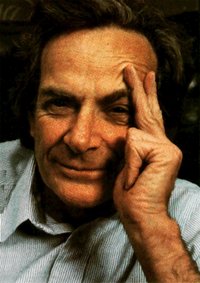
Richard Feynman©

"Science is the belief in the ignorance of experts."

Richard Feynman
His father, Melville, wanted a boy who would become a scientist. His mother, Lucille, wanted her child to have a sense of humor. Both got their wish. Richard won a Nobel Prize in Physics in 1965, and his quirky sense of humor would stay with him throughout his life and add to his legend.

Melville had emigrated from Minsk, Byelorussia in 1895 when he was five. In 1917, he married Lucille, whose parents had come from Poland. Shortly after Richard was born on May 11, 1918, his father bought him puzzles and arranged colored tiles in front of his highchair to intrigue him with the patterns. Richard did not begin talking till he was two, but made up for the slow start by repairing radios before he was ten and devouring the Encyclopedia Britannica from cover to cover. Self-taught in so many fields, he learned elementary mathematics before he began school and he won the New York University Math Championship when he was a high school senior.

He was accepted at MIT in 1935, earning grades in mathematics and physics that were among the highest ever recorded. After early resistance because of a de facto Jewish Quota at Princeton, he was admitted in 1939 to pursue his Ph.D. After he received it in 1942, he was offered a job on the Manhattan Project. At first, he rejected the offer, but after only a few minutes he realized Hitler might get an Atomic bomb first, and he changed his mind.

At Los Alamos, he amazed his seniors, solving problems that had baffled them while also learning how to crack safes and pick locks, a talent he used to prove to the army just how poor their security really was. Never taking anything, he left notes taunting officials with his breach of their systems.

Feynman had first met Arline Greenbaum when they were in high school. Over time, she became the most important person in his life and both felt star-crossed when they learned she was doomed with a diagnosis of Tuberculosis. Streptomycin was not yet available as a cure and Feynman could not abide the prospect of leaving her behind when he moved to Los Alamos.

Instead, over his family's objections, they eloped. He took her west with him and found her a sanitarium in Albuquerque. Early on, she had loved and supported his unique, fiercely independent personality.

For their wedding anniversary, she insisted he don a chef's hat and apron to grill steaks along Route 66, the highway which ran adjacent to the sanitarium. When he initially balked, she asked 'What do you care what other people think?' It was a line she had learned from him. He cooked the steaks, and used the question as the title of his last memoir, a book about Arline and his work on the Challenger Commission.

They wrote each other nearly every day and he drove the 93 miles from Los Alamos to Albuquerque to be with her nearly every weekend. He was with her when she died in July of 1945.

Following Arline's death, the bombing of Hiroshima and Nagasaki, and the end of the war, Feynman took a teaching position at Cornell, but ennui had set in. He became a notorious womanizer, partied and drank, and during his four years there he never moved into an apartment or a house. Over time, he found it increasingly hard to teach and he felt stale in his research efforts, though some of his work at Cornell helped him win the Nobel Prize.

While considering a teaching offer from Cal Tech, Feynman decided to take a sabbatical and teach in Rio de Janeiro. He also partied on the beach, learned to play Bongo drums and the frigideira --a Brazilian rhythm instrument -- and he danced the Samba. After 10 months in Rio, he accepted the Cal Tech offer and headed to Pasadena.

Over the ennui, he was brilliant. His work in those early years at Cal Tech might well have qualified him for three Nobels. The one he earned was '. . .for fundamental work in quantum electrodynamics, with deep-ploughing consequences for the physics of elementary particles.' He had come up with a technique for calculating the probability of a quantum transitioning from one state to another subsequent state and he adapted the approach to quantum electrodynamics to describe how atoms produce radiation.

When asked to explain in a few words what he had accomplished, he said, "Buddy, if I could tell you in a minute what I had done, it would not be worth the Nobel Prize."

He developed the Feynman diagrams which help in conceptualizing and calculating interactions between particles and space-time. They provide physicists with a clear, simple tool for envisioning atomic interactions and working with concepts that are otherwise hard to understand and use. The diagrams have since become a staple of today's physicists who work on string theory, and M-branes.

Feynman also explained the physics of the superfluidity of supercooled liquid helium. He used an equation, created by fellow physicist Schrodinger in another context, to explain the phenomenon. His insight was a great help in understanding superconductivity.

With Murray Gell-Man, he developed a theory involving the decay of a neutron into an electron, proton, and an anti-neutrino. The work ultimately resulted in the discovery of a new force of nature: the weak interaction.

Asked to help restructure the freshman physics course at Cal Tech, he devised a series of lectures which are still listened to and read by students and professionals some 40 years after he first delivered 'The Feynman Lectures.' The students loved him and vied for his attention. One solved an assigned problem and hastily dropped it into the mailbox at Feynman's home in the middle of the night. It woke Feynman from his sleep and he got up and read the answer. When a second student arrived with the answer during breakfast, Feynman told him he was too late.

Along the way, after a brief, failed second marriage, he met Gwyneth Howard, a British woman 16 years his junior. After a torturous romance, they married in 1960, staying together for the remaining 28 years of his life. Always something of a prankster and clown, Feynman titled his first memoir: Surely You Are Joking, Mr. Feynman! It became a surprise hit and stayed on the New York Times bestseller list for 14 weeks.

At Ronald Reagan's request, he served on the commission to investigate the Challenger space shuttle disaster. Unsatisfied with the emerging consensus that defended NASA from criticism, Feynman did experiments in his hotel room to test the theory that a lack of resilience in the rubber O-rings on the rocket boosters led to a leak of burning fuel, triggering the explosion. It was a fault NASA should have anticipated, but it was only because Feynman recreated his simple experiment during a televised hearing that people understood what happened and the bureaucratic failures behind it.

Feynman battled cancer for eight years until he finally succumbed on February 17, 1988. Until two weeks before his death, he continued to teach. True to form, his last words were 'I'd hate to die twice. It's so boring.'

His friend from high school days, Julian Schwinger, was also a scientific competitor and a co-winner of the Nobel Prize. Schwinger provided an epitaph:

"An honest man, the outstanding intuitionalist of our age and a prime example of what may lie in store for anyone who dares to follow the beat of a different drummer."