Sandy Koufax©
"Pitching is the art of instilling fear. Show me a guy who can't pitch inside and I'll show you a loser."
Sandy Koufax
"She (Koufax biographer and Washington Post sportswriter, Jane Leavy) says she talked to 469 people and none had a bad word to say about him. ‘Gentle’ was the word she heard most often."
USA Today Book Commentary 2/12/2003
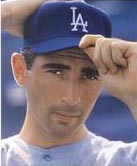
Sandy Koufax came from a broken home in Brooklyn, New York. He was born on December 30, 1935 to Evelyn (Lichtenstein) and Jack Braun. When Sandy was three, his parents divorced and for a while, he and his sister lived with their mother at her parents. When Sandy was nine, his mother married attorney Irving Koufax. For Sandy, Irving became his real father, a father who took the children to the Yiddish theater and encouraged Sandy's athletic pursuits.
Sandy was a gifted athlete who often shot baskets and played team sports at the Jewish Community Center. He loved basketball and his aggressive style of play led some to consider him "an animal." Among his high school basketball teammates was Alan Dershowitz. Koufax also played first base at Brooklyn's Lafayette high school, occasionally pitching in the Baseball Ice Cream League. In 1953, when he entered the University of Cincinnati to study architecture, it was on a full basketball scholarship.
The University of Cincinnati baseball team was headed to New Orleans and Florida to play games over the Spring break. To Sandy that sounded a lot better than heading home to Brooklyn, so he signed on to pitch for the road trip. In his first two games, he struck out 34 batters.
Sportswriter, Jimmy Murphy, saw him and encouraged Brooklyn Dodgers scouts to take a look. In 1954, they signed him for a $14,000 signing bonus and a salary of $6,000 a year. He was 18 years old and in the words of Dodgers' owner, Walter O'Malley, Koufax was "the Great Jewish Hope of the franchise."
Because of professional baseball's rules at the time regarding his large signing bonus, the Dodgers could not start Koufax on a farm team. They had to keep him active on the Brooklyn roster for at least two years before he could play in the minor leagues. The result was probably bad for the Dodgers and for Koufax. He was simply erratic. In his first start, he lasted just four innings, striking out four but walking eight.
The next time out, more than a month later, he shut out the Cincinnati Reds on two hits with 14 strikeouts. In his last two games that year, he only lasted one inning in the first game, and then, in the second, beat the Pittsburgh Pirates in a shut out on five hits with six strikeouts. Though the Dodgers won the World Series that year, Sandy warmed the bench. As Dodger executive, Buzzie Bavasi told him, "You have one pitch high."
Over his first six years as a Dodger, his record was 36 wins and 40 losses. Nonetheless, in the process, he tied Bob Feller's record when he struck out 18 batters in one game.
He almost quit in 1960, but showed up at spring training and asked to pitch more often, hoping it would improve his control. That was what everyone considered to be his problem - all speed and no control. About that time, Don Newcombe and Sandy's roommate, catcher Norm Sherry, (also Jewish), suggested he "ease off a bit." Sherry told him he thought he was "overthrowing" and could be more effective if he tried not to pitch so hard. Koufax listened, changed, and in 1961, won 18 games with 269 strikeouts for a league record.
The next year, he started out great, but a mid-season blood clot led a physician to suggest he might need to amputate a finger. He did not. Anticoagulants did the trick and Koufax ended the year with 14 wins, 14 losses, 209 strikeouts and an earned run average (ERA) of 2.06 with one no-hitter.
In 1963, he was outstanding. He won 25, lost 5, struck out 306 batters and pitched a record 11 shutouts. His 1.88 ERA made him the league's best for a second year in a row. And, he won two of the four games it took the Los Angeles Dodgers to win the World Series. He was unanimously named the Cy Young Award winner (best pitcher in the major leagues) and the National League's Most Valuable Player.
In 1964, he went 19 and 5 and in 1965, despite arthritis, he won 26 games, lost 8, and had an ERA of 2.04. He struck out 382 batters to break Bob Feller's record and he pitched a perfect game and his fourth no hitter. He won the Cy Young Award once more.
But that is not the story that lingers almost 40 years later. It was Koufax's decision not to pitch the first game of the 1965 World Series against the Minnesota Twins - because it fell on Yom Kippur - that Dodger fans never forgot. Though he became an icon in the mind of most of his fellow Jews, there were also many uncomplimentary and snide comments, including some in the press.
Koufax lost when he pitched the next day, but he pitched and won two subsequent games, including the seventh game on two days' rest. His pitching made the Dodgers world champions. He could take quiet satisfaction from the victories and from being named the World Series' Most Valuable Player.
The next year was a good one. He earned $135,000 and went 27 and 9. His ERA was 1.75 and he won the Cy Young for a third time. But arthritis was becoming a major problem and when the Dodgers lost the World Series in four straight, he retired.
Over that last six years, he was, in the words of biographer Jane Leavy, "sublime." "His motion was bio-mechanically perfect." He had literally studied the physics and knew precisely why this was so. Famed Pittsburgh hitter, Willie Stargell, once said that hitting against Sandy Koufax was like "trying to drink coffee with a fork." While his career was shorter than many other pitchers, in his prime, according to Leavy, "the beauty of his mechanics, what he could do with the ball, I'd say (and more to the point so does Willie Mays, Hank Aaron and Ernie Banks), no one did it better."
But that is not the end of the story. When Koufax quit, he quit. Though he was a radio announcer for a few years following his retirement, he simply led a quiet, private life and never tried to milk his career. He never earned money from endorsements. He avoided celebrity, and he has stayed pretty much to himself as he has lived in Maine and then Florida. While he was willing to let Leavy write her book about him (published in 2002), allowed her to interview all but himself and close relatives, and agreed to verify facts, she doubts he has ever read the book and thinks that makes "perfect sense." "He is," she says, "a notoriously private person." "He is celebrity before celebrity became an entitlement."
Sandy Koufax was a remarkable mix. He was a fierce competitor on the basketball court ("the Animal of Bensonhurst") and on the pitching mound. His style of pitching was determined and aggressive. Yet "gentle" was the word most often used to describe him. He was unwilling to give up on himself in six frustrating years as a Dodger and he vindicated that determination in a subsequent record that made him, at 36, the youngest inductee in Baseball's Hall of Fame. He has remained modest and shy around people he does not know, but he's no hermit. He was never afraid of being different, whether that meant not pitching on Yom Kippur, walking away from baseball when he thought his arm had had enough, or living a quiet life ever since.
In the end, Leavy talks of the era in which he grew up. "Those post-war years were giddy with the can-do mentality. They were the children of their parents' expectations; anything that was imaginable was do-able. The time was pregnant with possibility." She talked to 469 people and not one of them had a bad thing to say about him.