Saul Bellow©
"What a woman does for her children, what a man does for his family, what people most tenaciously cling to, these things are not adequately explained by Oedipus complexes, libidos, class struggle, or existential individualism – whatever you like. Now I know that psychoanalysis has found . . . the unconscious. A writer is supposed to go there and dig around like a truffle hound. He comes back with a truffle, a delicacy for the cultural world. Well I don't believe that. . . That's not the way it really is."
Saul Bellow
"The living man is preoccupied with such questions as who he is, what he lives for, what he is so keenly and interminably yearning for, what his human essence is."
Saul Bellow
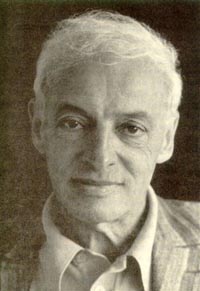
Saul Bellow was 80 when he nearly died. Poisoned eating toxic fish while visiting the Caribbean in 1995, he developed near fatal pneumonia. Only an extended, exhausting effort by his fifth wife, Janis, returned him to health. More than 50 years had passed since his first book was published and it had been 19 years since he had earned the Nobel Prize for literature. For most, advanced age, the near death experience, and an extended recuperation would have signaled the end of a long and successful career as energy and intellectual powers drained away. Not so for Bellow. He became recharged. He published The Actual in 1996 and Ravelstein in 2000 - the later a major work based on the life of friend and colleague, Allan Bloom. In 1999, an 84 year old Bellow celebrated the birth of Naomi Rose, his fourth child and first daughter.
Abram and Lescha (Gorfin) Belo emigrated from St. Petersburg, Russia in 1913 settling in Lachine, Quebec, an immigrant working class suburb of Montreal. Abram first imported Turkish figs and Egyptian onions before becoming a bootlegger. Their fourth child, Saul, was born, June 15, 1915. Before he was four, the family relocated to a mostly Jewish slum in Montreal where Lescha enrolled him in Hebrew school, hoping he would grow up to become a rabbi or Talmudic scholar. Watching neighbors die during the Great Influenza plague of 1918, a bout with tuberculosis that put him in a Royal Victoria Hospital ward for six months, a beating and the near arrest of his father for bootlegging, the family's escape to Humboldt Park Chicago in 1924, and the loss of his mother when he was 17 were all traumatic for the bookish, diminutive Saul.
His tonic became the rough and tumble atmosphere of 1920's Chicago. It honed and hardened him. There was vigor in the rich mixture of Jews, Poles, Germans, Italians and Russians. Chicago combined meat packing and heavy industry, railroads, Mafioso, innovative architecture, jazz, sin, wealth, and slums. There, the writings of Theodore Dreiser, Upton Sinclair, Willa Cather, Frank Norris, and others promoted a social realist atmosphere. Chicago's vitality helped shape Bellow into a young radical activist and intellectual. Though interested in writing, a professor told him Jews would never understand English literary traditions. Bellow shifted his aspirations, studying anthropology and sociology, first at the University of Chicago and later at Northwestern where he received his degree, with honors, in 1937. In 1938, he entered the University of Wisconsin graduate school, but, over Christmas vacation, he fell in love and dropped out of school to marry fellow leftist Anita Goshkin.
In 1940, after a stint at writing while working for Encyclopedia Britannica and the WPA, Saul and Anita traveled to Mexico to meet Leon Trotsky (Bellow's inspiration as a revolutionary socialist). Ill fated, they arrived the day after Trotsky had been murdered by Stalin's henchmen.
It was a time when Hemingway was ascendant. French existentialism, stoic pessimism, and Freudian theories were in vogue. Nihilism, alienation and a dour outlook arose from World War I, The Russian Revolution, Lenin and Stalin's repression, the Great Depression, and World War II. In this 30 year period, perhaps 100 million lives were destroyed, including six million Holocaust Jews. Nuclear weapons and the emerging Cold War only exacerbated the pessimism. Avant-garde intellectuals scorned bourgeois middle-class American life and values. If not a Hemmingway fan, for a time at least, Bellow was engaged by Nietzschean philosophy, oedipal conflict and the cultural views of the intellectuals of The Paris Review.
His first book, Dangling Man, was published in 1944. It depicted a would-be author anticipating the World War II draft call-up. The protagonist sought isolation intending to grow spiritually and intellectually as contemporary forces weighed on him. He studied Enlightenment writers and vacillated as he tried to cope with his anxieties. Ultimately in despair and alienating himself from everyone around him, the final scene has him standing naked amidst his fellow draftees in the real world of military induction. It was probably no coincidence that Bellow was inducted into the Merchant Marine in 1943. His next book had a not dissimilar feel. The Victim published in 1947, involved post World War II Jewish alienation and an occasionally self critical view of anti-Semitism. It won Bellow a Guggenheim Fellowship.
Somehow, in the midst of all this, and despite his earlier Trotskyite convictions, Bellow began changing. The striking evidence of the shift came in his third book. His Guggenheim fellowship provided sufficient funds to move to Paris for two years. He lived with Ralph Ellison who was then writing Invisible Man. Increasingly skeptical of the alienation expressed by his peers, Bellow reverted to a semi-autobiographical world of Depression era Chicago with its rogues ("picaresque" was the term used by most reviewers), matriarchs, and a coming of age to be experienced only in that time and place. "I am an American, Chicago born . . . and go at things as I have taught myself, free style, and will make the record in my own way." These were the book's first words. It was a modern Huck Finn, or urban Yearling, more akin to J D Salinger than Marjorie Rawlings, in a story extending into early adulthood. The Adventures of Augie March, published in 1953, established Bellow with its rich characters, vivid images, and romantic relationships. This was a unique, gritty American voice, mostly set in Chicago. Often humorous, the book bespoke a completely different outlook from what Bellow had depicted in the two earlier novels. It was breezy and if not "optimistic", it was certainly not despairing. And like Dickens, it was more fun to read.
The Adventures of Augie March won Bellow the National Book Award and praise from critics: "(Bellow's) body of work is more capacious of imagination and language than anyone else's . . . If there is a candidate for the great American Novel, I think this (Augie March) is it." said Salman Rushdie in The Sunday Times (London) "The best postwar American novel, The Adventures of Augie March magnificently terminates and fulfills the line of Melville, Twain and Whitman" said James Wood in The New Republic. "The Adventures of Augie March is the great American Novel. Search no further," said Martin Amis in The Atlantic Monthly
Bellow followed Augie March with a succession of mostly acclaimed books:
- The Wreckers - 1954
- Seize the Day – 1956, about failure and success in society that treasures only success
- Henderson the Rain King – 1959, about an eccentric millionaire on an African quest
- Herzog – 1964, a 1965 National Book Award winner, about the inner life of the cuckolded professor Moses Herzog
- The Last Analysis - 1965
- The Arts and the Public – 1968
- Mosby's Memoirs and Other Stories - 1968
- Mr. Sammler's Planet – 1970, a 1971 National Book Award winner, reflecting Bellow's increasing disdain for the liberal establishment through the eyes of a Holocaust survivor
- Technology and the Frontiers of Knowledge - 1972
- Humboldt's Gift – 1975, Pulitzer Prize winner, a comic tragedy based on Bellow's relationship with Delmore Schwartz
Bellow was increasingly anti-Freudian. He criticized the decline of Western humanism and the diminution of the value authors and critics placed on the individual. Culture was deriding individualism, diminishing it and moving inexorably toward what today may be termed Marxist deconstruction. Major social movements, rather than the individual, were ever more in vogue and viewed as determining behavior. Cultural equivalence and political correctness were arriving on the scene and Bellow roiled against them both. Bellow became politically incorrect. With the increasingly contrast of his views versus those of the university culture, he became anathema to some of his colleagues and many students. Radical students booed him from the stage at San Francisco State College during the early 1970s. But, he would not back down.
His 1976 Nobel Prize was a fitting riposte to his critics. It was a supreme accomplishment. In his acceptance speech, Bellow echoed his perspective. He reveled in the rich descriptive, story telling tradition of Joseph Conrad against the pessimists. At the same time, some began to wonder if the Nobel would signal the end of his greatness as it had for Sinclair Lewis, Pearl S. Buck, Ernest Hemmingway and John Steinbeck before him. Was his career fated to decline? Even Bellow was worried.
The passing years have proven Bellow was not about to decline. After 1976, Bellow published roughly the same number of major works as before the Nobel. Among them:
- To Jerusalem and Back – 1976, a non-fiction work involving Bellow's mixed feelings about Israel
- The Dean's December – 1982, contrasting Communist Romania with Capitalist America
- Him With His Foot in His Mouth and Other Stories - 1984
- More Die of Heartbreak - 1987, concerning modernity and its disconnectedness
- A Theft: a Novella - 1989, featuring Bellow's first female protagonist
- The Bellarosa Connection – 1989, created from a story overheard at a dinner, the protagonist attempts to repent a life of being aloof
- Something to Remember Me By – 1991
- It All Adds Up: From the Dim Past to the Uncertain Future - 1994
- The Actual – 1997, about reclaiming love in middle age
- Ravelstein – 2000, the semi-autobiographical story of Allen Bloom and Bellow
Along the way, Bellow went through four marriages, and three offspring, before Janis, his fifth wife arrived for what proved to be his most enduring, satisfying, and loving relationship - and one that produced a daughter in 1999. Bellow taught writing at the University of Minnesota, New York University, Princeton, the University of Chicago, Bard, and Boston University. He also received many honorary doctorates and the France's highest literary distinction for non-citizens, the Croix de Chevalier de Arts et Lettres.
Still irascible in his late 80s, critics called him a narcissist, a racist, a profound political and literary conservative, a lifelong womanizer and raconteur, and prickly. He was, in the view of some, simply not very likeable.
Bellow responded as always: determined, engaged, and informed. Though realistic about the potential for failure, he was positive and outspoken, often humorous, sometimes drawing on a wry, sarcastic wit. He derided categorization and the notion that all humans are merely representations of the groups to which they belong. Having grown up with views akin to his critics, he knew where he ultimately came down, and why. He rebelled against the "Wasteland" view of humanity and political correctness. Something of an Emerson individualist, his themes typically encompassed personal quest and crises rather than action stories. His protagonists were often urban men, sometimes disaffected or discontent with society. Perhaps alienated, even threatened as they explored existential questions, they were not destroyed. Some were Jewish intellectuals reflecting and talking within themselves on deep, comic, occasionally absurd matters, but they remained in the real world, in touch both with the intellectual and the tangible. They combined cultural sophistication with street smarts. The perspective made Bellow original. He affirmed life and the potential for individual human greatness. In his own words after surviving seafood poisoning and pneumonia, "When I opened my eyes 82 years ago I found myself suddenly here, in existence, which struck me as marvelous, tremendously moving and energizing. I'm here, this is my life! . . . You want to get a grip on that, to clutch that sense of what it is to be in the world."
Bellow died on April 5, 2005, a couple of months shy of his 90th birthday. His most fitting epitaph may come from his own words, "There is only one way to defeat the enemy, and that is to write as well as one can. The best argument is an undeniably good book."
