Dianne Feinstein©

"Toughness doesn't have to come in a pinstripe suit."

Dianne Feinstein
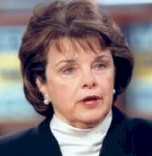
For most San Franciscans over 40, the memory of Dianne Feinstein's November 27, 1978 press conference announcing the assassinations of Mayor George Moscone and Supervisor Harvey Milk remains vivid. She was distressed but controlled. She heard the gunshots, had seen the killer, former Supervisor Dan White, in the moments between the two murders and he had rebuffed her attempt to talk to him. She raced to Milk's office, saw the fatal wound, tried to take his pulse, but knew immediately he was dead.

Only nine days earlier, 913 people, mostly former Bay Area residents, had committed mass suicide with Reverend Jim Jones in Guyana. The same year, her second and much loved husband, neurosurgeon Dr. Bertram Feinstein, had died of colon cancer. Though she had been contemplating retirement after returning the day before from a trip to the Mt. Everest area where she met the Dalai Lama, on that November day it fell to Dianne Feinstein not only to tell the world of the assassinations, but to step into Moscone's shoes as acting mayor. The very human and capable way in which she handled the situation, and later restored confidence to the city, proved her abilities. She vaulted to the forefront among California Democratic leaders.

She was born Dianne Goldman on June 23, 1933, the oldest of Betty and Leon Goldman's three daughters. She grew up in San Francisco's upscale Presidio Terrace neighborhood. Even today, when she is not in Washington DC, she lives in Presidio Terrace with her husband Richard Blum.

Feinstein was confirmed in the Jewish faith at 13 in a bat mitzvah, but attended a public grade school and, at her mother's insistence, a Roman Catholic high school. In Dianne Feinstein: Never Let Them See You Cry, biographer Jerry Roberts says she came from a dysfunctional home with an abusive mother, but her father, a nationally renowned surgeon, doted on her.

She transformed her family difficulties into a steely but velvet-gloved determination that has manifested itself ever since. She was the first woman president of San Francisco's Board of Supervisors, the City's first woman mayor, the first woman nominated by a major party to run for California's governor, the first woman to be considered a candidate for the Vice Presidential nomination, and the first woman senator in California.

She entered Stanford University in 1951 as a premed student, but soon shifted to political science and history. As a senior, she was elected student body Vice President. She graduated in 1955, interned with San Francisco's Coro Foundation, which provided political experience for young people, and in late 1956, married San Francisco prosecutor Jack Berman. They had a daughter, but within three years the marriage ended.

In 1960, when she was 27, Governor Edmund Brown appointed her to a seat on the California Women's Parole Board. She was the nation's youngest parole board member. In 1962, she married well—known neurosurgeon Bertram Feinstein, and it was to spend more time with him and her daughter that she resigned from the Parole Board in 1966. Shortly thereafter she was appointed Chair of San Francisco's Advisory Committee for Adult Detention and in 1969, she was elected to San Francisco's Board of Supervisors. As the leading vote getter, she served as the Board's President for five of her nine years on the Board. Twice, in 1971 and 1975, she ran for Mayor but was unsuccessful. Perhaps those losses led to her observation that "Winning may not be everything, but losing has little to recommend it."

Filling out Mayor Moscone's term, she earned great respect and was twice re-elected. During her ten years as mayor, crime dropped 27 percent, she balanced nine budgets in a row, and she cleaned up what had become a dirty, graffiti ridden city. In 1980, she married Richard Blum, a leading San Francisco financier who manages private equity partnerships.

In 1984, she was nearly nominated to run for Vice President with Walter Mondale but Geraldine Ferraro got the nod instead. Feinstein was nominated to run for California's Governor in 1990, but lost to Republican Pete Wilson. Her determination would not let her quit, however, and she ran for and won the 1992 race taking the Senate seat Wilson had vacated to become Governor. Two years later, she defeated Michael Huffington, Ariana Huffington's then husband, to serve a full six-year term, and she was re-elected to the Senate in 2000. When California Governor Gray Davis faced a recall in 2004, she wisely decided she preferred her Senatorial job and removed herself as the only candidate who might have defeated Arnold Schwarzenegger.

As a Senator, she was appointed to the prestigious Judiciary and Appropriations Committees, unprecedented for a freshman senator in 1992. She has since added the Select Committee on Intelligence, the Energy and Natural Resources Committee and the Rules and Administration Committee.

She has sponsored legislation no one expected to pass, got it through and signed into law. Her bills include: the Assault Weapons Ban, the Gun-Free Schools Act, the California Desert Protection Act, the Breast Cancer Research Stamp Act, the Lake Tahoe Restoration Act, the Headwaters Forest Agreement and the San Francisco Bay Wetlands Restoration Act.

Her voting record is liberal but her reputation is that of a frequently bi-partisan legislator. There is about her a distinctive blend of quiet firmness, warmth and common sense without the shrillness typical of some of her peers. She is optimistic and cheerful, if at times humorless. Pragmatic, she has carried a licensed concealed weapon while sponsoring the assault weapons ban.

She strongly supports women's rights, but in 1993, she opposed President William Clinton's nomination of Zoe Baird for Attorney General because of Baird's improper employment of illegal aliens. Though she strongly supports minority rights, she helped avert a tribal casino which would have been a blight north of the San Francisco Bay. Her successes have led to six honorary doctorate and law degrees and she was awarded the French Legion d'Honneur by Pierre Mitterand.

She remains an effective advocate for those causes in which she believes.