Andrew Grove©

"Only the paranoid survive."

Andrew Grove
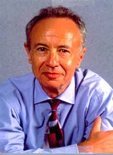
groveIn September, 1936, Hungarian Prime Minister Gyula Gömbös informed German officials he intended to establish a one party fascist state in Hungary. That same month, on September 2nd, András Grof was born in Budapest to secular Jewish parents. The first country to send a head of state to meet with Hitler, Hungary was dependent on the Germans for more than half its raw materials and markets. It would later send troops to the Eastern Front to fight alongside the Germans. The Soviets killed 40,000 of them and wounded 70,000 more. Later, German fears that Hungary might sign a separate peace with the Soviets or the West, led to a March 1944 German takeover of the Country. With that began the full scale deportation of Hungarian Jews to the death camps.

In the end, despite Hungarian government efforts to avert those deportations, only 260,500 of Hungary's 725,000 Jews survived the War. Grof and his mother were among them. They had changed their names (Grof became András Malesevics) and were taken in by Christians. Grof's father survived as well (but just barely) in the Eastern Labor Camps. Grof was not yet 9. It was his second near fatal experience. Five years earlier he almost died of Scarlet Fever.

The Soviets, who took control after the War, were not anti-Semitic in the fashion of Nazis but, as the Jewish son of a modestly successful capitalist dairyman, Grof experienced discrimination as "an enemy of the classes." Dismissed from a writing job in 1950 because a relative had been detained without trial, Grof is quoted as saying he "ran from writing to science." He said he "did not want to work in a profession where a totally subjective evaluation, easily colored by political considerations, could decide the merits of my work."

Though Grof was not part of the failed 1956 Hungarian Revolution, rumors the invading Red Army was rounding up students led Grof and his best friend to bolt. As students, they were fearful they too would be picked up. It was a harrowing escape. They got their directions from a hunchback smuggler who could just as easily have deceived them and turned them over to the Soviets. Shouts of "Who is there?" yelled at Grof as he lay "face down in a muddy field," terrified him. His hesitant response, "Where are we?" brought the reassuring reply, "Austria." Once more, the 20 year old Grof had averted disaster.

The International Rescue Committee helped him immigrate to the United States where an aunt and uncle, who had left Hungary in the '30s, took him in. He became Andrew Grove and he entered Manhattan's City College of New York to study chemistry. Perhaps it was the "C" he got in the English course on "Faulkner" (after speaking English for only three years) that kept him from being Summa Cum Laude, but he received nearly straight "A"s. The New York Times wrote of his success and his freshman advisor is quoted as saying, "I was a little astonished by that kind of ambition. There's some advantage in being hungry."

Meanwhile in 1957, while working as a busboy, Grove met Eva, a waitress and fellow refugee. By June 1958 they were married and in 1960, they headed for Berkeley, California where Grove, an outstanding student, earned his chemistry Ph.D. in June 1963.

His superb academic record, gave him his pick of prospective employers. He chose Fairchild Semiconductor. There, he would work with a legendary group of eight brilliant engineers whose efforts helped create what would later become known as "Silicon Valley." But in fact, it was Grove and two colleagues, whose solution to an "impurities problem" led to silicon's practical usefulness as a component in integrated circuits.

By the late '60s, Fairchild was losing its edge. The parent company had bought out the eight founding engineers and several had already left to start other companies. Robert Noyce and Gordon Moore placed a call to Arthur Rock to ask if he would help them secure financing to start Integrated Electronics (soon shortened to Intel). Rock responded "Yes" and Noyce and Moore then asked Grove to join them. They founded Intel in July 1968. (Grove is typically listed as Intel's Employee #4 – with Noyce and Moore #1 and #2 respectively. In fact, Grove's number and that of his fellow Hungarian émigré Les Vadasz were switched by mistake. Grove was #3.)

Noyce was to lead sales and marketing, Moore, research and development, and Grove would run operations. Some characterized it as the "dream team," but smooth sailing it was not. Intel was to face a series of life threatening crises. In each case, the responses, typically championed by Grove, would overcome the threat and take Intel to new highs.

Intel started out making dynamic random access memories (DRAMs) but soon pursued a separate opportunity. They could produce a small, general purpose device (a "chip") to replace twelve single purpose chips being requested by a Japanese calculator company. The new chip could be "programmed" to carry out a variety of different tasks and thus perform all twelve functions. When the calculator company later asked for a cheaper price to respond to fierce competition within the calculator industry, Grove and the management team negotiated the right to sell the chip to any company that did not manufacture calculators. With that, the Intel 4004, the world's first microprocessor, became a proprietary Intel product.

From 1976 on, Intel faced a series of crises in soft demand for memory, factory problems, Japanese "dumping," and other challenges. Grove led the responses. He made the decision to get Intel out of the memory (DRAM) business, to scale back, and to re-focus on microprocessors. He also played a key role in the IBM negotiations which led to Intel becoming the sole provider of microprocessors for the new IBM personal computer (PC). With that, Intel became the leading player in the booming PC business.

In 1994, after Intel had released millions of flawed Pentium chips, it was Grove who first had engineers tell customers the problem was nothing to be concerned about. Just as quickly, he realized he had made a horrible mistake. He reversed course and led a $475 million product recall. Incredibly expensive at the time, even for Intel, the decision ultimately convinced customers that Intel was committed to getting things right.

Within two years of Intel's formation, Gordon Moore had already decided Grove was the future of the Company. He told Grove "One day you'll run Intel." By 1979, Grove was President and in 1987, when Moore stepped aside, Grove took his place as CEO. He remained in that role for the next 11 years until 1998, staying on as Chairman for another six years until November 2004. Today, he serves as a senior advisor.

Through his thirty years, first as head of operations and later, through his time as the CEO, Grove's personality and style were the dominant force shaping the culture of Intel. Noyce and Moore were vital to the Company's success, but both were low key, not prone to confrontation, and the bulk of Intel's personnel reported to Grove. Subject to Board approval, Grove made the critical decisions.

One element of his style was coined "constructive confrontation." Anyone could - and did - challenge another's point of view and, at times, they did so with striking vehemence. As his successor, Craig Barrett was to tell the San Francisco Chronicle, "He yells at you, and you accept it because he's usually right. Sometimes you yell back at him. It's give and take, and anyone in the company can yell at him. He's not above it." Grove had set the tone. People were demanding of one another in a company that had a very low tolerance for mistakes. As one reporter indicated, it was a place of "ruthless intelligence." What mattered was not office politics, but the facts, intellectual honesty, merit, and performance.

Grove was known for his intense focus, his concentration and his penetrating eyes. He had a "quick violent temper" which, in 1984, caused Fortune Magazine to name him one of America's toughest bosses. On occasion, he went overboard as Time pointed out in its 1997 cover story. Once he became so heated that his later apology was not accepted. Another time, according to the book, Inside Intel, Grove berated a departing former star employee (Federico Fagin) saying, "You will fail in everything you do." Grove was high strung with an incredible sense of urgency and drive.

And Grove was willing to take the same kind of grilling and demands he dished out to others. Arthur Rock, a Silicon Valley legend for his abrupt brilliance, was as intellectually demanding in his role as an Intel Board member as Grove was of those working for him. Among other comments, Rock told Grove he did not think he could make it as Chairman.

But Grove was also courageous. He believed in tackling fear head on. In a Forbes interview, he said he regarded fear as a creative force, not an enemy: "It's fear that gets you out of comfortable equilibrium, that gets you to do the difficult tasks." Grove's life had so often placed him at risk, he developed remarkable survival skills. He believed crises are inevitable and unpredictable. To survive, a company must simply detect them and respond to them. Though Intel's arena may have been tougher and more tumultuous than most, Grove felt the same rules applied to nearly every organization, and his thoughts in that regard led to his book, Only the Paranoid Survive. It described the threats, opportunities, need for vigilance, and tools one might use to spot and capitalize on such changes.

At Intel, work began at 8:00 AM and there was no tolerance for arriving late to a meeting or for meetings that ran on and on with little being accomplished. Grove's office light was usually on late into the evening after everyone else had left. At the same time, Intel was egalitarian. Grove worked from the same 8-ft by 9-ft cubicle as everyone else. He parked wherever there was a space. His work area was accessible to anyone who walked by.

Those who have known Grove from the beginnings of Intel confirm that despite his success, and the wealth that came with it, he remains unchanged by everything he achieved. As Arthur Rock said, "He has no airs." He lives on a relatively modest scale, without his own jet or expensive cars.

During his tenure as Intel's CEO, revenues grew from $1.9 billion per year to $25.1 billion. Employment doubled to 64,000 people. The company became a global force with more than half its revenues, and many of its products, generated offshore. Over those years, the value of Intel stock grew 24-fold. At 31.6 percent per year, it was twice the rate of the S&P 500 Index. In a world of high performance and accountability, Grove had delivered.

If Grove was difficult at work, he was a loving family man at home. He has been married to Eva, the waitress he met in 1957, for nearly fifty years. Time magazine noted, "He is still clearly nuts about her" and "she takes care of him." "There is a world-worn gentleness in their touch." His daughters think of their mother as a "saint" and their father as "wonderful." His younger daughter said "Being Andy Grove's child is not for the faint of heart. But if you can roll with it, its great." At Intel, Grove worked to include his family in his business travels, but in a move some would find "typical," he expected his daughters to write reports on what they saw. And through it all his passion for physical fitness and his lifelong love of the opera remained a constant.

In 1994, Grove faced yet another life threatening crises. Told he had prostate cancer, he attacked the problem just as he had every other challenge in life. He schooled himself, obtained three expert opinions and then made a decision based on all the homework he had done. Eleven years since he chose high dose radiation, he appears, once again, to have made the right call.

In leading and leaving Intel, he demonstrated his commitment to proper corporate governance, drawing on a majority of outside directors to guide the Company and splitting the Chairman's duties from those of the CEO. He practiced everything he preached as he stepped down in November, 2004.

Wealthy from his own efforts, Grove intends to give away the bulk of his fortune. Prostate cancer research is one beneficiary. Ten chemistry scholarships at CCNY is another. The International Rescue Fund, which brought Grove from Vienna to America, is yet another. It will receive the profits from his memoir, Swimming Across. He also serves as Chairman of the University of California San Francisco's $1.4 billion capital campaign to build a major medical campus and hospital in San Francisco's Mission Bay. Grove is committed to education and feels the United States is falling badly behind. In addition to his efforts to improve the educational infrastructure, he continues as an active lecturer at Stanford University. Meanwhile over the years he has written 40 technical papers, five books and numerous articles and columns for Fortune, Wall Street Journal, The New York Times and others.

Ultimately Grove, like other first and second generation immigrants described in this book, found America to be a country in which he could be successful and not be resented for it. One manifestation of that was his selection as Time magazine's 1997 "Man of the Year." But as with so many other of its immigrants, America got the better of the bargain.

Grove embodies many of the Jewish cultural values described earlier in this book. He is assertive and willing to be different, but he is tolerant, even inviting, of competing views. He stands for choice and accountability, and has been a tenacious hard worker for his entire life. Unwilling to place himself in a role where he might have to depend upon the subjective views of others, he chose science and is intellectually honest and rational. He has always been devoted to his wife and daughters. His commitment to education is manifested not only in his Ph.D. (and many honorary degrees) but in his own writing, teaching and promoting of America's need to dramatically upgrade the quality of its educational programs and capabilities. And Grove is philanthropic. He might not use words like "heal a broken world," but in the end, he will devote the bulk of his wealth to benefit others.